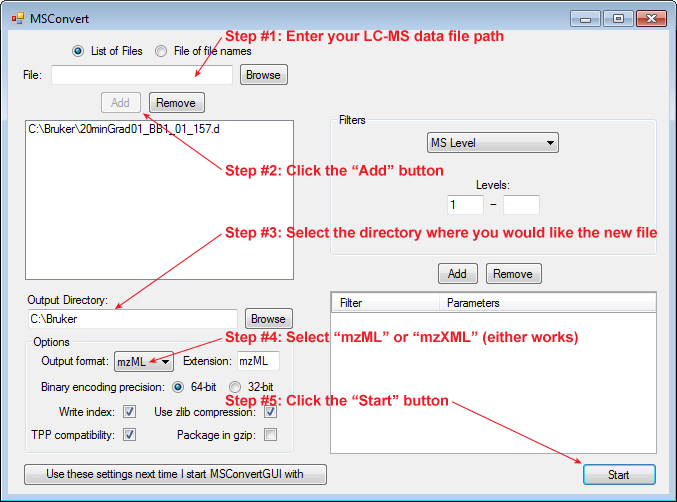
Click on the following link to run the LC-MS Column Tester application:
Launch the LC-MS Column Tester application
After clicking on the above link, a window will ask you to either open or save "columntesterapp.jnlp". Make sure "Open with" and "Java(TM) Web Start Launcher" are selected and then click "Ok".
Note: Some browsers may open the contents of columntesterapp.jnlp instead of running it. In that case, follow the instructions below for "Running LC-MS Column Tester Offline".
Once the application launches, you will see the following window:
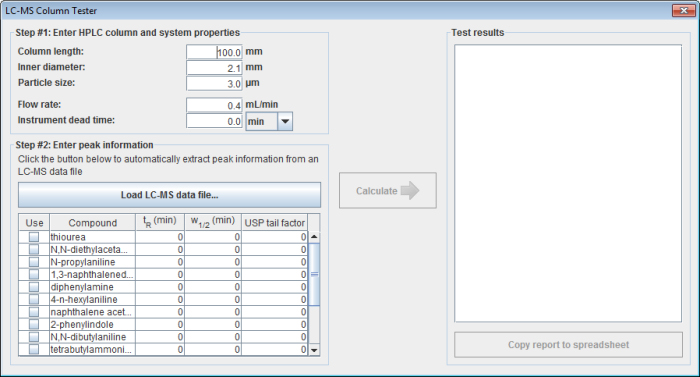
In this window, enter the following information:
1) Enter your column length and column inner diameter in millimeters.
2) Enter the particle diameter of your stationary phase. The particle size is used to approximate an expected efficiency for your column. It is also used to estimate the best level of filtering for your data when the software automatically extracts peaks.
3) Enter the flow rate you used when you ran the test mixture.
4) Enter the instrument dead time/volume. The selection box next to the instrument dead time box lets you select whether you want to enter it as a time or as a volume. If you enter it as a time, be sure it is scaled correctly for the flow rate used in the gradient.
5) Enter the retention times (tR) you measured for each of the standards in the Test Your Column test mix. You can manually enter in all the values or you can click the "Load LC-MS data file..." button to automatically extract the retention times from an mzXML, mzML, or netCDF file of the LC-MS run (see Step 5 above).
Try it out! Right click the link below and select "Save link as..." to download an example mzXML file. It was acquired on a 2.1 x 150 mm column (5.0 µm particles) with a 0.4 mL/min flow rate. The instrument dead time was 0.091 min.
 ExampleChromatogram.mzXML ExampleChromatogram.mzXML
6) Click on the "Calculate" button to generate a column evaluation report containing:
- Retention factors for each compound (k)
- Column selectivity parameters including
Hydrophobicity (HMS)
Steric interaction(S*MS)
Hydrogen bond acidity(AMS)
Hydrogen bond basicity(BMS)
Charge interaction(CMS)
- Number of theoretical plates (N)
- Height Equivalent to a Theoretical Plate (HETP)
- Column dead time (t0)
- Peak width at half height for each standard (FWHM)
- USP tailing factors for each standard
7) Click on the "Copy report to spreadsheet" button and then paste your report into your favorite spreadsheet software.
|