|
The Hydrophobic Subtraction Model (HSM)
The Test your Column methodology provides a fast and easy way to measure several properties of your reversed-phase HPLC column by LC-MS. One of the most useful properties it measures is your column's selectivity. It uses a test mixture of 16 chemically diverse standards (provided for free upon request) to measure each of the five major types of chemical interactions (hydrophobic, steric, H-bond acidity, H-bond basicity, and charge type) that your reversed-phase HPLC column contributes to retention. You might use this tool to compare the selectivity of two columns or to monitor the selectivity of a column as it ages.
The new methodology is based on the Hydrophobic Subtraction Model, a model that quantitatively describes the selectivity of reversed-phase HPLC columns according to the following equation:
log k' - log k'ref = η'H - σ'S* + β'A + α'B + κ'C
which is actually far less complicated than it looks. The term log k' - log k'ref simply describes the retention of a compound of interest relative to that of a reference compound. The other side of the equation is more interesting. Each of the terms η'H, σ'S*, β'A, α'B, and κ'C represent a different chemical interaction that contributes to retention. The small Greek letters are properties of a solute while the bold capital letters are properties of the column.
η'H: hydrophobic interaction between solute and stationary phase
σ'S*: steric resistance of bulky solute from entering stationary phase
β'A: hydrogen bonding between acceptor (basic) solute & non-ionized silanols
α'B: hydrogen bonding between donor (acidic) solute & unidentified acceptor groups on silanols
κ'C: interaction of charged solutes with charged sites on the stationary phase
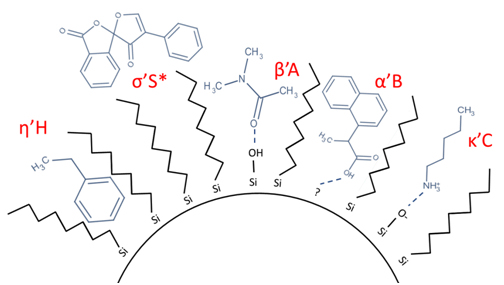
Every solute has its own η', σ', β', α', and κ' parameters and every column has its own H, S*, A, B, and C parameters. So if you know a solute's η', σ', β', α', and κ' values and you know a column's H, S*, A, B, and C values, you can predict the solute's retention on that column with very high accuracy (to ± 0.7% in k'!).
Conversely, if you know the solute parameters (η', σ', β', α', and κ')for a set of solutes and you know their retention on a particular column, you can calculate that column's H, S*, A, B, and C parameters. This information is extremely useful when you want to compare the selectivity of different stationary phases in a way that is chemically meaningful. In fact, Lloyd Snyder and John Dolan of LC Resources measured column parameters for more than 500 stationary phases from different manufacturers. Dwight Stoll of Gustavus Adolphus College continues to measure column parameters for new makes and models of HPLC columns. The column parameters are available at www.hplccolumns.org
A New, LC-MS-Friendly Version of the HSM
The Hydrophobic Subtraction Model is clearly very useful, but it has some important limitations that preclude it from being used in routine column testing or with LC-MS. First of all, the HSM uses a set of 16 chemically diverse solutes to measure column parameters, but many of them are not visible with electrospray ionization-MS, so an absorbance detector must be used to detect them. And since absorbance detectors cannot distinguish between the solutes, multiple samples (each containing only a subset of the 16 compounds) must be run in order to correctly identify all of the peaks.
On the other hand, if an LC-MS could be used to detect the standards, the retention of all 16 solutes could be measured in a single run. But even if the standards were all detectable by LC-MS, the standard chromatographic conditions the HSM was built upon are incompatible with LC-MS (30 mM potassium phosphate buffer in the mobile phase). They also do not reflect the chemical environment of mobile phases typically used in LC-MS (the ionic strength of 30 mM potassium phosphate buffer is approximately 50-fold higher than a 0.1% formic acid solution), so it isn't clear whether the column and solute parameters measured with the phosphate buffer have any merit under LC-MS-friendly conditions.
To develop a simple, fast methodology by which column selectivity can be measured using LC-MS, we developed a new LC-MS-friendly version of the HSM (details pending publication). We built the new system using a mobile phase comprised of 0.1% formic acid in 50% acetonitrile and a column temperature of 40 °C. Then we carefully selected a new set of 16 test solutes that are all detectable by LC-MS. You can now use the new methodology to easily measure your own column's HMS, S*MS, AMS, BMS, and CMS parameters (the superscript "MS" emphasizes that these parameters are not directly comparable to the standard H, S*, A, B, and C parameters).
This LC-MS friendly column characterization methodology has several benefits:
- All 16 standards are run simultaneously in a single mixture
- Standards can be easily distinguished using an MS detector
- Column selectivity parameters obtained with this model are more relevant for LC-MS conditions
- The Test Your Column application automatically extracts peak information from LC-MS data files and calculates your column's selectivity parameters
For step-by-step instructions on how to use this column characterization tool, please visit the Test Your Column tab.
|


